
Treating Sound as a Character

A cliché that is thrown around far too often, but is still very pertinent. In football, you would call sound the 12th man, bellowing support from the stands while the manager (the director) and the players (the actors) get all the media attention. After all, sound is better when it’s invisible, however, in this circumstance I want to talk about the instances where sound makes its debut and scores the winner in the cup final. Sound is, and always should be considered it’s own character. Of course sound design has to be subtle, as Walter Murch puts it ‘sound crosses the Berlin wall of consciousness without alerting the border guards.’ (1991, pg. 11) this means the audience must be aware of it, but never draw attention to itself.

A film I watched recently that uses sound beautifully is Darius Marder’s Sound of Metal (2019), a film that puts sound front and centre as it’s main character. In the film we follow drummer Ruben (Riz Ahmed) as he comes to terms with the fact he is losing his hearing. You may think that a film that follows a deaf protagonist will not need to have stunning sound but what the film does wonderfully is shift perspectives so we can not only hear what Ruben hears but also what the world really sounds like. Sound of Metal sound designer, Nicholas Becker had this to say about the shifting perspective ‘If you see the first part of the film, it’s really about how to create a vocabulary between sound and picture, with the subjective point of view.’ in this he is referencing that we spend the first half an hour of the film almost exclusively inside Ruben’s head, hearing, or rather not hearing what he hears. And what Becker has touched upon is really interesting, that being semiotics.

Sound of Metal (2019)

Semiotics refers to the relationship between sound and picture, and how meaning is communicated in that relationship. In it’s most basic form, sound design bridges the gap between the visual and the aural in a way that can be easily interpreted by the audience. However, there are some great examples of films that bend the rules of semiotics and make the relationship between sight and sound more complex. In The Conversation (1974) another collaboration between Francis Ford Coppola and Walter Murch, the opening scene is a puzzle box when it comes to sound design. It is largely unclear to the audience how what we are seeing and what we are hearing are connected, as the camera eerily zooms in we start to hear distortions which further our bemusement, that is until it is revealed that we are hearing a secret recording of the park. So instead of the usual omniscience you get as an audience member, we are put inside the head of the character. The most famous example of this type of filmmaking comes in Apocalypse Now (1979) yet another Coppola/Murch creation. In another opening scene, we are put inside the head of Captain Ben Willard (Martin Sheen) as he battles with PTSD and once again where the battle between sight and sound is put front and centre.

Apocalypse Now (1979)

As to how semiotics relates to my project, which is the kitchen scene from Ratatouille (2007). We spend almost the entire run time inside Remy’s head, so we hear what he hears. This is particularly pertinent in the kitchen scene because things that wouldn’t to be threatening to a human are life-threatening to a rat and the sound design reflects this. Something as simple as a human footstep, is innocuous to a human but for Remy it is earth shattering, creating a big booming noise as it passes by him. Similarly, falling in a sink isn’t an issue for a human, but for Remy he is simultaneously trying to stay hidden from the kitchen staff and trying not to drown. One of the most underrated decisions a sound designers has to make is perspective, who’s perspective are we experiencing the sound from? Because the answer can make all the difference to a scene. If the sound design for Ratatouille was done from an omniscient perspective, we would experience a complete disconnect and furthermore a lack of empathy for Remy, because we would see him for what he is; a rat. When in reality the movie shows us he is so much more than that.

GROBAR, M., 2021. Sound Designer Nicolas Becker Gets Inside Experience Of Deaf Drummer On ‘Sound Of Metal’. Deadline, Jan 7,

Sound of Metal, 2019 Directed by Darius MARDER. USA: Amazon Studios

SHULEVITZ, J., 1991. FILM; When Sound Is a Character. The New York Times, Aug 18, 11

The Amazing Career of Randy Thom

There have countless articles, videos and documentaries that have delved into the careers of writers, directors and actors however, the most under appreciated career trajectories are that of sound designers. Now the name Randy Thom may not instantly conjure up an image of flashing lights and red carpets but if I said Jumanji (1995), Cast Away (2000) Harry Potter (2002-2005) and The Revenant (2015), those are names you have heard of and Randy Thom is responsible for the aural half of those movies cinematic appeal. So why Randy Thom? And not Walter Murch? or Gary Rydstrom? or Ben Burtt? Well Thom actually has another credit that I haven’t mentioned, he is responsible for the sound design for my favourite Pixar movie, Ratatouille (2007). A soundscape that I am going to try and recreate over the few weeks; eek! So let’s dive into the career of one of Hollywood’s most prolific sound designers, Randy Thom.

Randy Thom

Born David Randall Thom in August 1952, Thom began work in radio in 1970 but quickly turned his attention to cinematic sound in 1975. So Thom would start at a ground level and work his way up to more challenging projects, so as an entry point he was hired as a sound recordist for Apocalypse Now… wait what? I thought he was starting off small. Thom began his sound designing career as mix assistant to the most famous sound designer of all time, Walter Murch, on the film that would change cinematic sound forever. Not a bad way to start. Through working with Francis Ford Coppola, Thom would work his way into the inner circle of Coppola’s contemporaries; working with Ben Burtt on Star Wars: Episode V (1980) and Raiders of the Lost Ark (1981). I could go on all day with a list of credits but what it boils down to is that Randy Thom was able to gain experience working with some of the most successful sound designers of all time.

Through this experience Thom and Murch have almost mirroring ideologies when it comes to the relationship between sight and sound. This being that less is more and that sound can be more abstract than originally conceived by early sound designers. In a 2000 paper entitled “Designing a Movie for Sound” Thom wrote ‘that starving the eye of information forces the brain to use the ear for information’ (2000, pg. 8) this meaning that by limiting the audiences exposure to visual clues they have to decode the scene by using aural clues instead. Thom goes on to suggest that ‘It’s usually not a good idea to “sonify” every single thing in a scene that could conceivably make a sound. It’s better to choose, and through that choice create a little story vector.’ (Thom in Farley, 2012) this idea of withholding information from the audience can be just as powerful as providing information to the audience, something that echoes the famous quote of Martin Scorsese when he said ‘Cinema is a matter of what’s in the frame and what’s out.’ and those parts that you leave out are equally important to the final product.

Thom won his first of two academy awards in 1983 for his work on Phillip Kaufman’s The Right Stuff (1983). His second would come in his first collaboration with Pixar and director Brad Bird, with 2004’s The Incredibles. Three years later the pair teamed up again for Ratatouille. The scene I will be trying to recreate is the kitchen scene, in which Remy scrambles around the perilous kitchen trying to find an escape route. When talking about particular sound details he was proud of Randy Thom mentions an element from this scene ‘The gas fire in the oven that almost burns Remy alive was made from about a hundred gas stove “flame ups” cross-faded with each other’ (Thom, 2007a), now this does frighten me slightly because there is no way I can record 100 gas stoves sparking up, not least because I have an electric hob. However, it does give me some room to differentiate myself, for better or worse, from Thom when recording this sound in particular.

Randy Thom working on Ratatouille (2007)

Another element I have given a lot of thought to because it’s so key to the scene is the mix of music and SFX. Thom mentions later in the same interview about how he tackled this ‘Well, Brad Bird did most of the coordinating of music and sound effects on Ratatouille. I’ll usually suggest a couple of places where I’m hoping the score will be sparsely orchestrated enough to allow key sound effects to be heard.'(Thom, 2007b) the last thing I want to do is push Michael Giacchino’s music into the background, however this is a Sound Design unit and not a music score unit, so my sound needs to be prominent. One thing the original scene does brilliantly is blending elements of the Giacchino’s score with Thom’s sound design and this is something I hope to recreate. Thom admires this as well, saying ‘The action sequences I admire, and the ones that tend to stand the test of time, are the ones where music clearly dominates in some areas, and sound effects clearly dominate in others.’ (Thom, 2007c).

MURRAY, L., 1968. Sound design theory and practice : working with sound. London: Routledge

RIEHLE, J., 2007. “Ratatouille” – Exclusive Interview with Sound Designer Randy Thom. Designing Sound, Jun 26,

A Brief History of Sound Design

A long long time ago, in this galaxy, movies were born. It is unknown what is officially the “first ever film”, but we know it was released in the late 19th century and they were nothing more than a series of still images linked together with frighteningly no sound. This iteration of the art form would include intertitles, put simply; these were frames of film with text on them, usually used in place of dialogue or sound effects so that the audience could fill in the gaps. This was good but there was still something missing. Music would then be played live in auditoriums were movies were being shown, which was the first use of sound in cinema. Entire orchestras would be set up in the pit below the screen to play along with the movies, meaning every time the movie played, the experience would be minutely different. And for a while this was enough for people, music synchronised to a moving image. What happened next would blow the brains of the people of the roaring 20s.

Silent Movie Orchestra

Al Jolson was a titanically famous singer and comedian who made cinematic history on October 6th 1927, as the first person to speak on screen, in movies or television, for his role in Alan Crosland’s The Jazz Singer (1927). Discounting this movies enormous historical significance it was also a commercial home run, grossing around $2.6 million, which may not sound like much by today’s standards, but adjusted for inflation that money is worth $39.5 million today. And from that point on that is how movies were made, microphones on set to record the actors which encouraged the emergence of the traditional Hollywood studio soundstage; because the microphones were so temperamental and extremely sensitive, soundstages needed to be built in order to record clean enough audio.

Al Jolson in The Jazz Singer

Although leaps and bounds were being made in the music industry with artists like The Beatles and their producer George Martin making use of stereo recording, no such progression was being applied to film. That is until 1976, when Barbara Streisand insisted on implementing Stereo sound to A Star is Born. A feat that cost her $1 million of her own money. But this decision along with the rapid developments being made by Dolby Digital at the time, signified a turning point in cinematic sound which was about to be blown out of the water by the godfather of sound design, Walter Murch.

Speaking of The Godfather (1972), this was a watershed moment for Francis Ford Coppola and his contemporaries as they would go on to dominate the next 25 years of cinema. Steven Spielberg, Martin Scorsese, George Lucas and Francis Ford Coppola, all friends, are widely considered some of the best and most influential filmmakers of all time. However, simultaneously we were experiencing a renaissance in sound design. George Lucas first met Walter Murch at USC in 1965, and Lucas went on to introduce Murch to Francis Ford Coppola in 1969, a relationship which would go on to span many decades and produce countless critical acclaim.

Left to Right: Martin Scorcese, Steven Spielberg, Francis Ford Coppola and George Lucas

In the same way these four directors would help each other over the years, the same thing was happening in the sound department. When Walter Murch wasn’t available to work on Star Wars (1977) with George Lucas, he recommended Ben Burtt, who went on to win an academy award for the film. Similarly, Pixar co-founder John Lasseter, originally wanted Ben Burtt to do sound design for their first short film Luxo Jr. (1986), but Burtt wasn’t available, so along came Gary Rydstrom, who has since won a staggering seven academy awards.

Let’s rewind a little bit back to 1979 when Francis Ford Coppola embarked on what would become notoriously known as the most difficult film production of all time. I am of course referring to Apocalypse Now (1979). Francis Ford Coppola literally and figuratively went through a war to get this movie made and he wasn’t interested in cutting any corners, this is includes the sound design. He got the man he trusted the most, Walter Murch, to champion the sound design but not to sell himself short Francis Ford Coppola asked Walter Murch to design the sound not in mono, not in stereo, but in full 360º. Up until this point Murch had only worked in mono. But he and his team made up of Richard Beggs, Mark Berger and Randy Thom got to work and 18 months of sound editing and 9 months of sound mixing later, the film was done. The rest is history.

Francis Ford Coppola (Center) and Walter Murch (Right)

This six-track full 360º audio is more or less the sound we still use today, albeit at a higher quality with Dolby Atmos. However, there is still a little bit more innovation to be squeezed out of the history of sound design. As I mentioned briefly earlier, Luxo Jr. was the first of Pixar’s now illustrious filmography and Gary Rydstrom pioneered something we take for granted nowadays. Up until Rydstrom started work on Luxo Jr. sound was still being edited and mixed in analog. Rydstrom was the first person to design sound on a digital device, which is something we all have access to nowadays with programmes such as Audacity and Audition.

And this is whereabouts the innovation ends; sound is now being captured, edited and mixed digitally. Cinemas have now embraced the 360º sound which was pioneered by Francis Ford Coppola and Walter Murch.

Evolution of Story Symposium- work experience

On February 19th 2020, Solent University hosted it’s first ‘Evolution of Story’ symposium, a series of panels given by various storytellers and academics about how far storytelling has come and will continue to go. I was asked if I would like to come along and film the event as well as be a data wrangler for the shoot. The event took place from 10am until 5pm and we had to be shooting pretty much the whole time so it took a bit of organising in order to charge batteries and swapping out SD cards every couple of talks because we didn’t want anything to run out halfway through a talk. The event took place in a lecture theatre so getting power and finding a place to store the equipment were more hurdles we had to overcome in order for the production to run smoothly.

There was a full livestream broadcast on the day on the Solent Media YouTube channel, however I was part of the team filming from the back of the room and was more focused on doing close-ups which could be later edited into highlights and were taken from a more attractive angle than that of the livestream. We worked with a relatively large team for this event. We had Steven and I, who were the camera operators, Maddie who was the producer, James who worked on the livestream, Tom who was in charge of audio and Anna who was the photographer. This size of team allowed us to bounce ideas off each other quite a lot and gave us a lot of help in terms of logistics.

What I learned from this project is the importance of a data wrangler in a big production, how to use a large team to your advantage and also a lot about professionalism on a set.

Project hours: 8

Total hours: 38

Southampton Christmas Light Switch On – work experience

Back in November I got the opportunity to go to Southampton’s light switch on event and film it with my friend James. This was one of my favourite work experiences thus far because it felt truly one of a kind. Me and James worked very independently because we got given complete creative freedom by the organisers. The equipment we brought with us was two Canon XC15 because they are very versatile in terms of focal length and have good in-camera image stabilisation. We also brought one tripod so that one of us could stay stationary at all times and capture what was happening on stage, the other would be mobile and capture close-ups for the most part. We were able to film everything from the performance from East 17 to the light switch on itself from the Southampton FC players.

After the event me and James headed back to editing studios where we cut up a quick 3 minute highlights video which we then sent back to the organisers. In conclusion, I really liked this experience because of how independent it allowed me to be, but at the same time allowing me to work in a team and communicate with James as and when I needed to.

Project hours: 5

Total Hours: 30

Cursed City Finale Gig- work experience

Back in November last year I was lucky enough to be involved in the final event of Darkfest, the cursed city finale gig. I was also involved in filming the event that started Darkfest, the Snow Witch art exhibition, which took place about a month prior. The team stayed much the same for this event as well which was a nice sense of familiarity. For the main portion of the event I worked using the Ronin S camera gimbal which was mounted with a Canon XC15. I had only used the Ronin S once before so it took some adjustment to get comfortable with but once I did it’s a very powerful piece of kit. My friend James edited the video at the bottom which prominantly features my videography.

After the main performance but before the live music from the band, Raka, we were able to use the downstairs bar area to conduct some interviews with the actors and writers which was really cool because it wasn’t prepared for. I was able to interview a couple of the participants and think on my feet when it came to questions. I also took the opportunity to sit behind the camera for one of the interviews which I also really enjoyed.

Overall I am really pleased with how the event went and again just happy to be involved in such valuable work experience and working with more amazing people.

Project hours: 10

Total hours: 25

How does music influence us?

Despite how cutting edge locative audio apps are, there have a variety of studies in human response to sound and music in particular. Three professors from the University of Nottingham conducted a study into musically guided walking experiences. They start by noting the day to day influences that music can have on us. They highlight that ‘People now routinely select music to accompany physical activities, curating their own mobile soundtracks.’ (2014) these mobile soundtracks can be in the form of Spotify or Apple Music playlists or just sporadic music that people choose to play when doing particular activities. They also explain that humans subliminally ‘mirror physical actions to match the tempo of the music’. I can Playing pianosay from personal experience that this is very true. If I am going to be typing something that is quite long I will listen to piano music, usually without lyrics so it almost feels like I am playing the piano when I am typing. Personally, I get distracted by anything that has lyrics or is too electronic when I am trying to work, so I purposely listen to classical music. They go on to explain how music driving spatial attachment at various levels. The way I interpret this is that music can bring back memories and remind you of a certain time or place. An alternative viewpoint is that tone of music can influence how you feel or can influence how you physically move. This moves us onto how they attempt to prove this hypothesis.

The study was relatively simple, they would place participants in the centre of a field and play them all the same piece of music, from there the participants would move where the music takes them. As they move to different areas, different pieces of music would play causing different reactions and further emotionally charged movements. When they experiment finishes they would analyse how different music influence participants. What they found was that tone was very important in influencing direction, for example C2 (a piece of music that was played) was scary and encouraged people to move on from that area. Also interestingly, participants were influenced by the lack of music and they found that ‘silence can be used to indicate an end or ultimate arrival or to disengage’ (Hazzard).

In conclusion, as to how this influenced my project in particular I think although we didn’t use music throughout the app, we tried to use elements of the sound mix to influence the how the user would move for example as you approach the church, you would subtly hear church bells which would ultimately urge you towards that area.

HAZZARD, A., S. BENFORD and G. BURNETT, 2014. Walk this Way: Musically Guided Walking Experiences.

The Emergence of Geo-Locative apps

Geo-locative apps are by the far the most cutting edge technology I have tackled thus far in my degree. Despite their simplicity and the similarity they bare to tech used in places like museums and guided tours, it has now fallen into the hands of fictional storytellers. In a journal by German cartographers Indans, Hauthal and Burghardt, these cutting edge applications are broken down and I am going to attempt to make sense of it myself. They Headphones subwaystart by comparing this technology to the visual AR (augmented reality). They recognise the shortcomings that audio can have in comparison in that ‘audio information cannot augment reality to the same extent however with subtle changes can create a seamless experience’ (2019). So where visual AR attempts to transport you to another world, audio attempts to add light and shade to try and enhance the real world. However, audio can be just as immersive, they explain it as ‘an acoustic envelope’, so although visual AR can take you to another place altogether, the audio creates a smoother transition into that world. Although visual AR is the one that has become more mainstream I would argue that the audio is actually more important. I think that visual AR would not survive without audio but audio AR can survive without visuals.

The cartographers go on to provide examples of applications that have succeeded in creating immersive audio experiences for their users. For example, ‘Zombies, run!’ is a jogging app that encourages users to run faster to evade zombies that are chasing them pokemon godown. It also challenges users to improvise running routes in order to avoid zombies. The app provides a map however the main element is the zombie sounds that are triggered when you encounter a zombie or are being chased by one. Reading this reminded me of another game that required users to get out and about in order play, ‘Pokémon Go’ which was a massive phenomenon when it was released by Niantic in July of 2016. Although this app leaned more into the visual AR than the audio it’s geo-locative gamification is something that was highlighted in the journal. Gamification is something I really wanted to lean into when creating our app as well. I think our story being a murder mystery would really benefit from gamification elements to help drive the story forward.

The final element touched upon by the cartographers was the idea of personalised experience. This is the idea that users can pick their own time and place in order to create their own experience of the audio track. This could be done with audio books or maybe a particular favourite soundtrack. Of course with our app, users have to be in a certain place to enjoy the experience however they are still able to customise the time they go to the place. The experience may be calmer in the morning or more scary at night. It all depends on what you want to get out of the experience. But again this all links back to the immersiveness of locative audio. You create your own experience with the audio provided and I think locative audio has a very bright future because of it.

INDANS, R., E. HAUTHAL and D. BURGHARDT, 2019. Towards an Audio-Locative Mobile Application for Immersive Storytelling .

What is Narrative Fiction?

As we move closer to our deadline of our geo-locative audio app it’s time to put some thought into our critical reflection. Now our brief states that ‘critical reflections require you to evidence a critical and creative enquiry into narrative fiction as it relates to your specialist individual production project’. But what is ‘narrative fiction’? So I’m here to tell  you.

In the book written by Marie-Laure Ryan entitled ‘Towards a definition of narrative’ Ryan says that ‘Narrative is about problem solving, conflict, interpersonal relations, human experience and the temporality of existence’ (2007). So let’s break that all down. Firstly, problem solving, without a problem to solve the story doesn’t move, we are stuck in a endlessly easy cycle of life, nothing to overcome. There needs to be mission to complete, a task to conquer a villain to defeat, otherwise the narrative is pretty bland. Secondly, conflict, every narrative has to have some friction or tension in order to built up some suspense or keep the audience engaged. Next, interpersonal relationships, human to human contact, the audience need to feel something: something to hate, something to love, something to cry at. Next, human experience, this is all about growth, that’s why character arcs are important however they need to grounded for the audience to understand them and relate to Supermanthem personally. Finally temporality of existence, this is about time and more importantly about lack there of it. Death essentially. We need to know that the characters in the story are at risk. That’s why I’ve never liked Superman, he’s pretty much invincible, an alien, who looks like a human who can’t die, what’s interesting about that? All narratives have to come to an end, that’s what temporality of existence means.

Ryan also breaks down narrative into 4 dimensions, of which she believes all narratives must have: Spatial dimension, temporal dimension, mental dimension and formal and pragmatic dimension. Spatial dimensions refers to the idea that ‘the world must be populated with individuated existents‘ (pg.29a) which I interpret like a video game. A crowd of people in a video game usually don’t have intelligence, they are just told by the programmer to walk and maybe talk, but no backstory or complexity.  So, for a story world to feel real and lived in these characters must have backstories and complexes. The temporal dimension refers to the idea that ‘the Bill and Tedworld must be situated in a certain time and that limitation of time can be used to create tension’ (pg.29b) for example Bill and Ted’s Excellent Adventure (1989) works solely due to the fact that they must submit their assignment by the end of the day. Thirdly, the mental dimension, ‘some participants in the event must be intelligent agents’ (pg.29c) this means that characters must have thoughts and feelings to challenge and react to the events of the story world. Finally, formal and pragmatic dimension, which is the one I disagree with the most, as it states that ‘the sequence of events must form a unified causal chain and lead to closure’ (pg.29d) which I don’t think is necessarily true, closure isn’t always needed, it can be disappointing for audiences but if it is grounded in truth then closure can be ignored.

Eling oldNow, as to how this relates to my particular project. My story is called ‘The Story of Will Trodd’ and is a murder mystery adventure set in the late 1950s. So in terms of the first 5 aspects of narrative I spoke about my story has problem solving as it is a murder mystery. It has conflict as you encounter the characters alongside the main character. There is small interpersonal relationships between characters like the sailors. The main characters is forced to undergo change and learn new things as you travel through the story world. And ultimately the temporality of existence is front as centre because someone dies. As we are limited to the 6-8 minute run time it is difficult to cram in all the complexity that Ryan speaks about and its difficult for me as first time fiction writer but I’ve tried to draw inspiration from movies and Tv shows I have watched and hopefully the end result is as good as I think its going to be.
RYAN, M., 2007. Toward a definition of narrative .

Freelancing Week 5- Personal Development and Creative CVs

This week I learned about the specifics of personal development plans and the importance of creative CVs. Firstly, LEGO. We were given identical bags of LEGO pieces and were asked to build something and explain how it could relate to our future career. I really liked this task because it allowed us to look in an abstract way at how we see

IMG_4503
Figure 1: My LEGO creation

ourselves in 5 years time. I built a sort of bulky hovercraft/boat (see figure 1) and it was kind of inspired by the idea of travelling with work and being able to work on the go. I really like the idea of being able to work anywhere in the future, which is very plausible in the creative industry. This is an interesting task because whilst allowing us to be creative literally, it allowed us to get creative in our future planning which is always good.

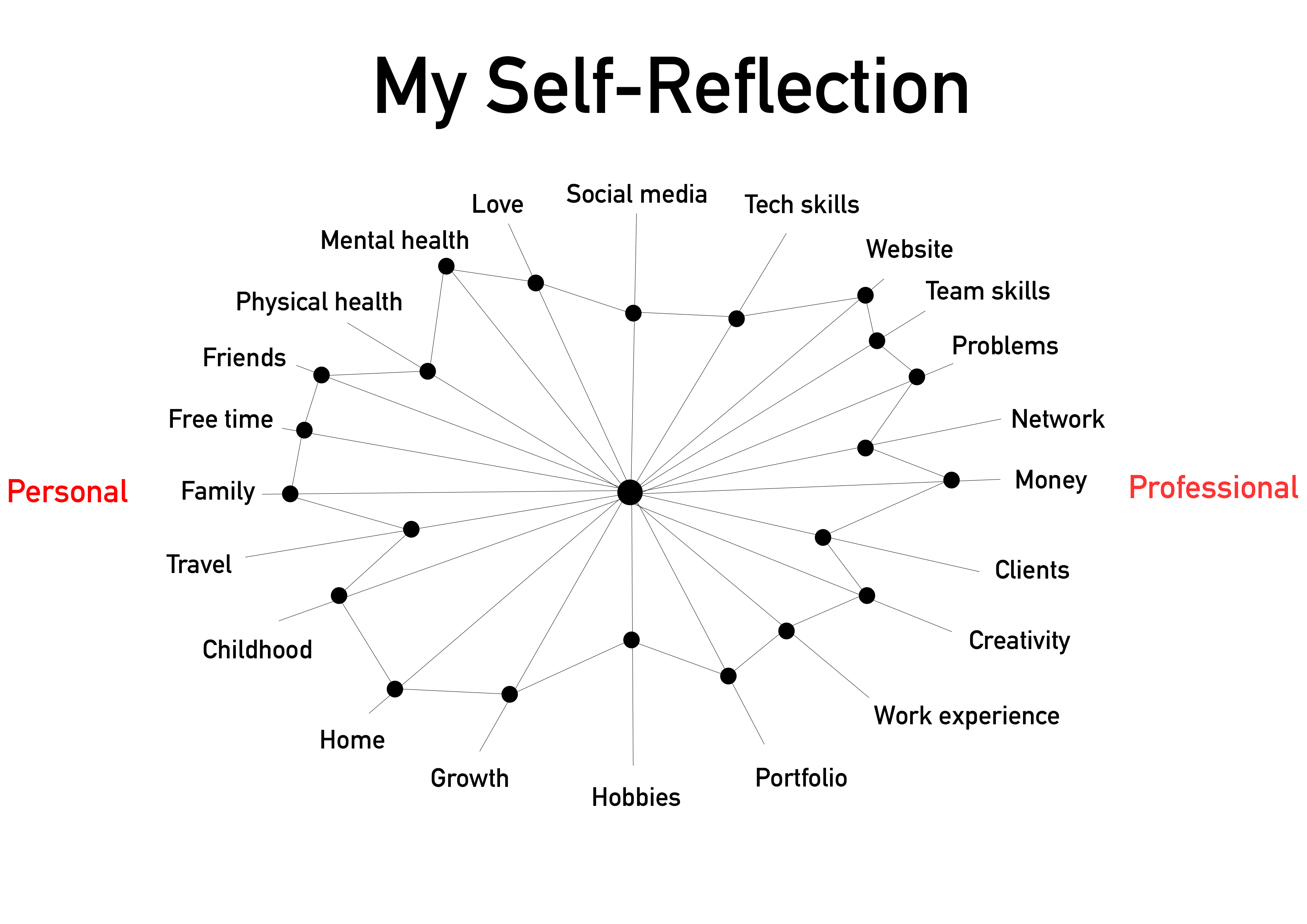
We then moved onto a more literal self-assessment task in which we looked at our

My self reflection
Figure 2: My self-reflection

personal and professional lives and what elements make up those aspects and forming a circular shape which can be seen in figure 2. We then ranked them using dots to create see what aspects can be improved in our lives to help the shape be more well rounded and this can be used to inform what we put on the personal development plan. In this exercise I learned that I need to improve my networks, clients and hobbies. My personal life is definitely the stronger of the two sides. but overall there is nothing too drastically bad on it but definitely some areas for me to improve.

Finally, we looked at creative CVs, so this is something I have already looked at in the professional practice unit last year but it was good to look at again because there’s always room to update and improve your CV. I think for me, one year on it is important for me to look through it again and update it how I’m feeling now and where I see myself in 5 years.